Providing HR support and advice to SME across the UK since 2006
CASE STUDY

The three-way team of the Company, its Lawyers, and its HR advisors delivered and protected significant shareholder value in selling a small business at a high multiple to a much larger trade buyer in late 2023. I hope that this will be of help to business owners contemplating a sale at some time.
Much like selling your house, where the “Survey” is an opportunity for a price, let’s say, “adjustment”, lower than what was offered. This nibble, this haircut, this price chip, call it what you will, is a major problem for owners and management Shareholder value who have invested a vast amount of energy getting within clutching distance of a major earning event.
A bad due diligence outcome hits you right at the point of maximal pain, can scupper the deal, but more likely just weakens your negotiating position and destroys some of what you see as fair recompense for your life’s work. Get the process right, you sell with less friction, you move the business on with momentum, and with an easier negotiation of Warranties and Indemnities.
In my case, I was delivering a 3-year turnaround and sell brief for a fine 20-year-old digital business that had failed to sell under the previous management and a different advisory team. This time around, the Corporate Finance Team at Buzzacott were excellent, ran a good teaser campaign, shortlist and pitch process, and we ended up with half a dozen buyers, all big, and at tremendous valuations. This case study is about what we did with our other advisors to retain as much of the offer as we could and to de-risk the sale. I’ll make the argument that an investment in advisory fees in advance of the deal process has a strong financial ROI and will help you deal with the firehose of stress coming your way.
I’d bought two and sold one before, and each time, I hated the 20-hour days at the end. It's not macho, it's bro-dominated testosterone nonsense, and you can save yourself a ton of pain and actually go home from time to time.
Why? How? Think of it like this: Someone in your buyer is going to be running interference, either from a desire to see less risk for their firm, or because they want to spend the money differently. Either way, the dark forces inside your buyer are just given oxygen if they find fault, and you will get tied up in their politics at a delicate stage when you need to be fully defending the big value differentiators - your sale projections, your product’s brilliance, or your market growth stats. If you are dragged into warfare on DD, your bigger buyer has people lined up to shred you for their dismal negotiating benefit. There might be only one of you; your risk-taking and wheeler-dealer style might have got you to here, but it won't get you through a sale against professional trade buyers. It's a bandwidth problem. Think about it.
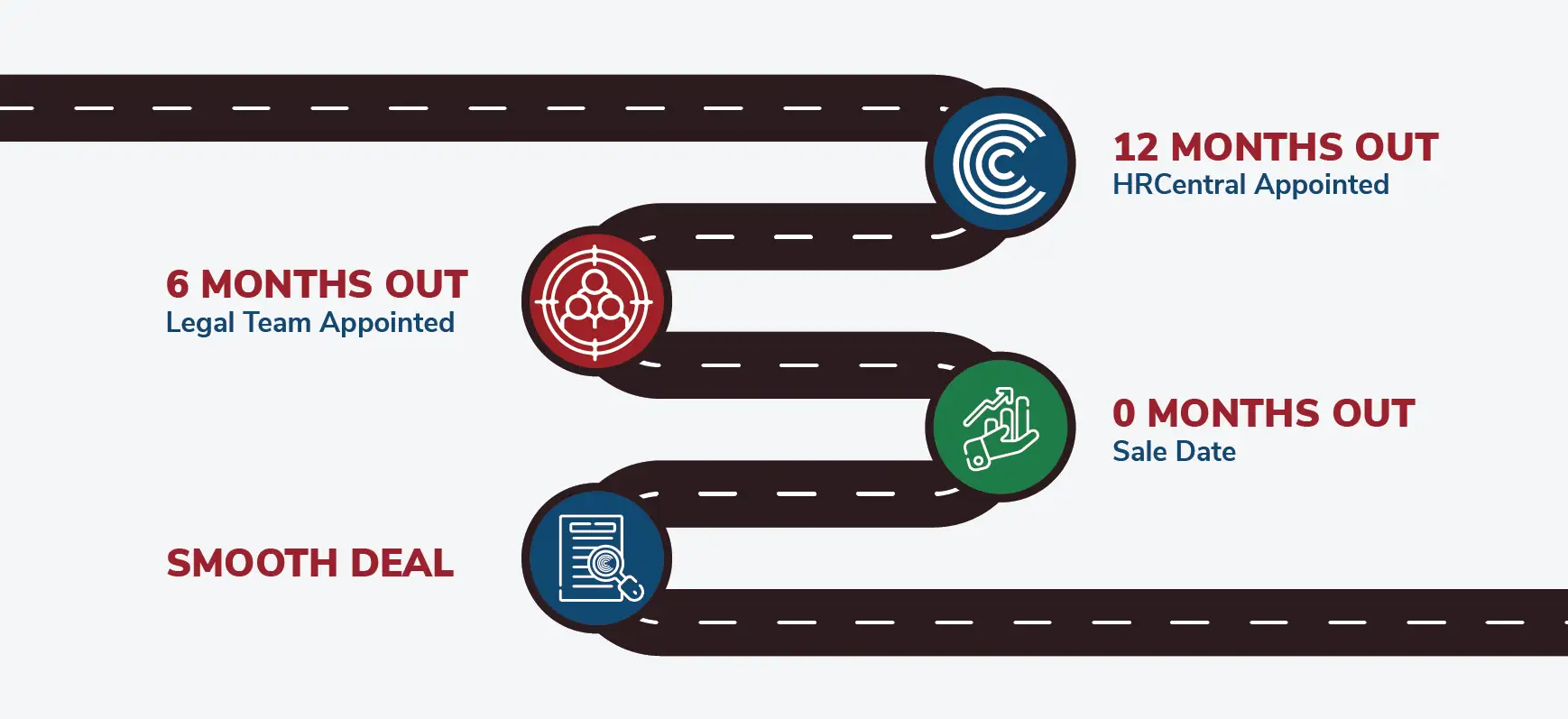
We, as a Shareholder group, decided to masterplan better and appointed HRCentral, our HR consultants, to look at our readiness for sale a year out. Then we did the same once we had appointed Boyes Turner as our Corporate and Employment lawyers. I’d advocate strongly that you do the same. You may have taken on that ace sales director and given them a different contract than others, and this is where it comes back to bite you. The buyer wants to see a piece of due diligence paperwork that shows all staff on contract, all contracts the same, and all contracts on a modern template. If you have a heap of mad contracts and versions, that is just a risk, and, at the 11th hour, you can't go back to your staff and make up a story as to why they need to sign a new contract by this Friday. Deals fall apart on these risks.
Better that you look at your staff contracts, all your policies and procedures 12 months out and use it as an opportunity to clarify everything, even load in some decent rewards in the event of a sale. You do not want resignations during your sale. The things that kill your deal are highly sector-dependent, but if people work at height, you’d better have some solid Health & Safety policies in place, for example. You need dull stuff like a copy of insurance for each company car driver on file. Not sexy, not seemingly value adding.
One that we had to navigate in our sale was that the Share Options EMI (Enterprise Management Incentive) scheme was splendid in all respects, other than HMRC had not signed it off, as we had failed to have a valuation. If we had not fixed it, the buyer would have extracted something from us for the risk in dealing with it. Depending on your scale or stage of development, personnel records, hiring plans, and succession plans are all things that add value or add risk to your buyer's appreciation of your business. “Hmmm, No whistle-blower policy…hmm, let’s assume a worst-case scenario and hold back £xxx on the exit payment…..” The cleaner you can be, the more your buyer will think that you run a tight ship, and you remove horrible friction when you are up against it.
As an aside, a 12-month HR project gives you time to hire those who might complement your personal limitations, to bolster your credit control function, or to remove from play a problem employee. A senior colleague who can be relied upon to frighten investors might be a hilarious non-conforming cultural icon in an SME business, but we all have a sell-by date. Don't wing it - plan around it.
To make the sale of our business happen with the minimum risk, I felt it was important to have the Corporate Finance people, HR people and Legal team aligned with our plan and to nut out over a lunch who was going to do what, when and who had the lead on x, y, and z over a six-month period. This was the best £500 I’ve ever spent.
With Boyes Turner and Buzzacott, we wargamed the deal so that we had a plan for maintaining our negotiating leverage. Often, when the buyer has an exclusivity period, they will somewhat deliberately faff about before they mobilise their due diligence team, appoint their people and so on. An SME is somewhat at a disadvantage here, so the terms of the exclusivity needed to be negotiated, not imposed.
The big-ticket items, like asking if your Articles of Association, Partnership stuff, and company paperwork are all up to date, are critical, obviously, but compliance certification documentation, evidence you own your mailing list for GDPR, or have the boiler service warranties in your office building, become strangely important. Not having a Fire Certificate and some really weird small stuff just caused vesuvian explosions in this MD’s office. The one that sticks in my mind was that the buyer would not accept as valid a share certificate that had someone's old address on it. Grrrrr, no, people will not take a view. Yes, it's petty, but they are giving you a lot of money, so suck it up, kiddo!
To get ahead of this before we got into the beauty parade, we had Boyes Turner supply us with their standard due diligence questionnaire and have an corporate lawyer talk us through buy-side expectations. Even if you are very organised, give yourself a month with that process and maybe a quarter. There is a forensic job to be done here - the things you say in your Information memorandum must align exactly with the content in your due diligence. The document repository, in whatever form it is, is your evidence base, and that is what you will end up personally warranting. It all gets very real and very personal at this time. Missing a bank statement from 3 years ago? Find it.
Go back a few paragraphs - the dark forces in your buyer are going to go to town on this due diligence. What you say can hang you, and as MD, I was skewered on several occasions by questions starting “When you said this, did you mean that, as we read the due diligence submission differently?” At this point in the deal, you will be exhausted, however epic a businessperson you are. You are within a few yards of the line, with a potentially life-changing amount of money at stake, your shareholders are tired too, and you need your professional team on the front foot, winning arguments about how much cash to keep, how little to warrant, and how good your personal future deal is. What you can avoid, by planning, is a huge disappointment where you have been hung out for ages, and you accept a big price drop just to make the brain damage stop.
In one deal, we did have a headline price chip; it was painful, but we managed it because we had most of the rest of the issues under control, and still had the bandwidth and good advice, to use it to win a different argument about tax treatment for part of the deal. My point is, you can't do that, and the chip will be much deeper if you fail to invest time and effort with your advisors in squaring away the dullest admin in advance.
The argument that it is risky for you to spend thousands on potentially abortive advice is weasely. What if it is not abortive, and your failure to plan costs you 1% of your exit price? - that could easily be £100k. My experience is that any investment you make in a due diligence / HR project like this has a clear payback in tidying up issues, whether you sell now, later, or not at all. Clearly, the title of this piece is wrong. It's provocative. You have made the money, your amazingness has made the difference, but what you might think of as management treacle and admin makes sure you receive your payout. Perfect, preparation, prevents….you know the rest.

Like the irritating recent Virgin Media advert, you need to be as smooth as a walrus on a speedboat on a flat calm sea…. during the acquisition period. You are engaging across your business metrics, your new sales, and bullish in your evidence of increasing gross profit on valuable accounts. That’s full-time. You can't be messing about on a Saturday night trying to find a copy of your property landlord’s Cyber Emergency plan. It's not a good look, and your life partner will thank me.
I thank you for reading, and the teams at Boyes Turner Solicitors, HRCentral, and Buzzacott for delivering for my Shareholders.
This project was a classic example of why HR due diligence isn't just about 'compliance'—it's about shareholder value. By starting 12 months out, we were able to harmonise contracts and fix the EMI valuation gaps quietly, rather than under the intense pressure of an exclusivity period. When the buyer's 'dark forces' arrived to look for reasons to drop the price, the HR rug was already firmly tacked down.

HR due diligence identifies potential liabilities—such as non-compliant employment contracts or missing policies—that a buyer can use to “chip” or lower the final sale price.
Ideally, 12 months. This allows enough time to update staff contracts, ensure EMI schemes are HMRC-compliant, and address any “problem” employment issues without the pressure of a looming deadline.
Missing employment contracts, lack of GDPR compliance regarding mailing lists, and unvalued share option schemes are frequent issues that add risk to a buyer’s appreciation of the business.
Yes. Buyers often use gaps in HR compliance (like missing whistleblower policies or outdated health and safety records) as leverage to negotiate warranties, indemnities, or a lower exit payment.